
About Grubs
“White grubs” are the most serious turf insect problem found in Southwestern Virginia. “White grub” is a generic term for the larval stage of several different types of beetles, the most common of which is the Japanese Beetle.
The adult Japanese Beetle emerges in late June or early July and almost immediately begins laying eggs that hatch out in late July to early August. The newly hatched larva feed vigorously on grass roots at this time and can cause turf damage. The damage to the turf is caused by the severing of the roots, which causes brown dead patches of grass to appear in the yard. A tell tale sign of grub damage is that the turf will pull up easily because of the severed roots.
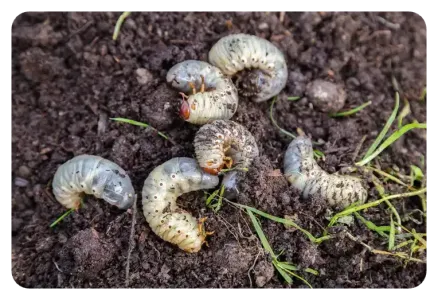
Our Preventive Grub Control Treatment consists of a granular application of the insecticide Imidacloprid. Imidacloprid is very effective at controlling white grub larvae. It has a three month residual effect to give long term control. Since white grub larvae hatch out in late July or early August, Imidacloprid must be applied in June so that it is already active in the soil and grass when the grubs begin to feed. If applied according to the label directions, Imidacloprid will give almost 100% control of white grubs.
A side note is that homeowners will often find grubs in the soil in the early spring and become concerned that they should begin treating for grubs in the Spring. The grubs found in the Spring are mature grubs that cause little to no turf damage and are hard to control with insecticides. It is not recommended to try and control grubs in the Spring but to wait and control the next generation of grubs that will come along in the summer.
An Imidacloprid application will not eliminate all grubs but will reduce the grub population to a level where there will be NO noticeable turf damage.